There’s a moment you may have missed when you first use a chatbot. You type in your brief, the response comes back, it reads roughly right and kinda professional. On a good day it might be up there with your best work. So you use the response and you keep using the chatbot.
What you probably don’t realise, because few do, is what’s actually happening underneath.
Teach someone to knit a cable pattern and they’ll produce cable pattern jumpers beautifully and consistently.
It won’t be any cable pattern, it’ll be the particular cable pattern that they were trained on. The output is competent, reliable, and structurally identical to the input they learned from.
This isn’t a limitation, because for jumpers pattern consistency is the whole point.
Teach someone to tie shoelaces and it’s broadly the same: they learn to loop, cross and tuck, and from that day they tie every pair of shoes in exactly the same way; again a good outcome.
But what if you needed that person to do something else with the laces?
Every neighbourhood, every era, every tribe develops their own language signatures. For example, “Ken?” is Scots shorthand for “Do you understand?” It’s compressed, local and very efficient. “Know what I’m sayin’?” is far less efficient, but builds rhythm and invites agreement at the end. “Yo bruv” provides acknowledgement, respect and solidarity in two syllables.
These aren’t random uses of language, they’re patterns absorbed by people who grew up hearing those phrases. They used them until they became native, natural and automatic.
You don’t say “Ken?” or “Know what I’m sayin’?” because you have, in a conventional sense, chosen to. Rather, you say them because the pattern was installed within you by your environment. To put it another way, your linguistic fingerprint was shaped long before you were aware it was being shaped. And it’s here that things get interesting.
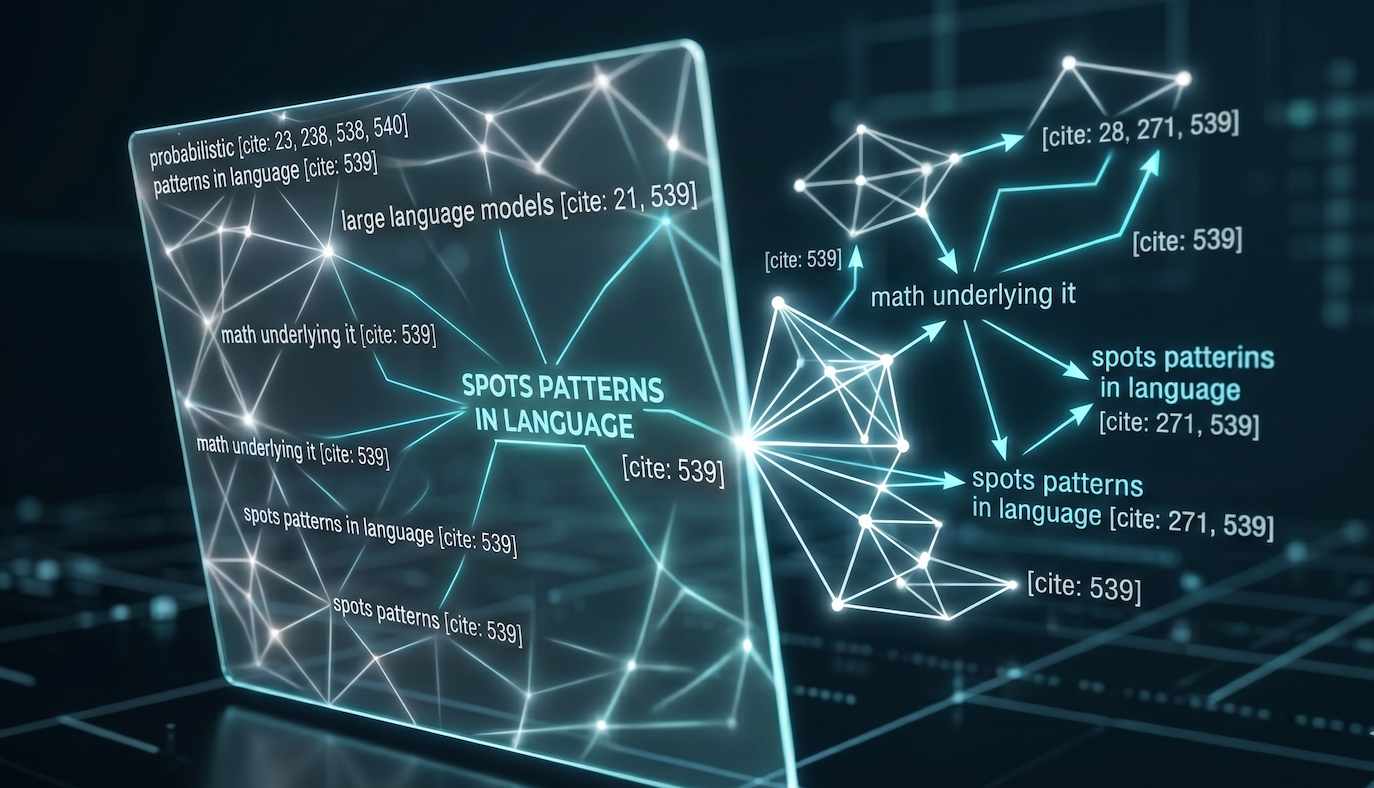
Every chatbot you’ve ever used, be it ChatGPT, Gemini, Copilot, or Claude, is based on a large language model (LLM) that was trained on text, specifically the written output of billions of humans across the web. Articles, emails, blog posts, marketing copy, Reddit threads, whitepapers, LinkedIn posts, academic papers, Wikipedia entries, were, and continue to be, all part of the mix.
Having been exposed to all this text, the models learned language patterns and so became able to predict which word, phase or structure should follow the last one. The training was never meant to teach the model to understand what it was saying or to reason from first principles. It was simply to observe patterns and to reproduce something statistically consistent with them. Essentially it’s the knitting and the shoelaces scaled to a trillion examples.
Here’s the question that almost no one who uses an LLM asks: Which patterns did it learn? The answer is not the best ones, not the most effective ones, nor the ones that converted the most prospects, moved people the most, or drove actual behaviour change.
The answer is that it learned the MOST COMMON patterns, ie the ones that appeared most frequently in the training data. This of course means ones that were written by the greatest number of people across the greatest number of contexts. In maths it’s known as the modal output, but think of it as the statistical centre of gravity.
This explains why, when you ask a chatbot to write you a marketing email, you’re not getting the sharpest, most specifically calibrated message possible. Instead you’re getting a weighted average of every marketing email ever written by everyone who left a trail on the web.
Similarly, when you ask it to write a pitch, you get one that most resembles others’ pitches, and when you ask it to describe your product, you get words that most people have used for products roughly like yours.
This is nothing like marketing intelligence. To repeat, it’s a regression to the average.
And the thing about averages is that they’re comfortable because they are familiar. Everyone who reads them has seen roughly that pattern before, because that’s exactly what the model got trained in.
And, since comfortable outputs rarely get complained about, it’s a safe position for the chatbot corporations to occupy. Average outputs, being highly predictable, are computationally efficient and therefore scale at lower cost.
While the average is good for the corporations, it’s quietly very bad for your marketing. That’s because marketing’s main job is to disrupt patterns, not to confirm what someone already thinks. It must create moments of recognition that pull potential customers out of autopilot and prompt a decision.
The most effective headline you ever saw didn’t sound like every other headline and the pitch that won you that huge contract didn’t feel like a pitch you’d heard before. The messages that trigger the actions you want didn’t arrive as a comfortable, familiar cluster of words you’d encountered a hundred times. They arrived as something that deviated from average; something a pattern-trained system cannot produce.
Every business that uses the same chatbot to produce the same kind of content for the same kind of audience is training their own customers to see their output as background noise, because it sounds like everyone else’s background noise.
Your voice, the one thing that should accumulate into brand equity over time, gets dissolved into the same tepid soup of competent, inoffensive, deeply average language. Your marketing output might skyrocket, but the pattern-based text quietly replaces the one thing that’s guaranteed to works: a point of view that no one else has.
At Write Arm we use a new, non-LLM-based form of AI called SDCI™ (Synthetic Deterministic Cognitive Intelligence) that’s based on decision science. Unlike LLMs, which guess based on probability, it’s designed to understand your business and your customers’ buying triggers. These unique analytical abilities deliver an average conversion uplift of 76%. Find out more here.